Most people don’t mind getting freebies—getting something for nothing. Beekeepers
aren’t the exception. They always need to find ways to save a bit of money with
their beekeeping.
Whether it is just a hobby or a full business, it can be expensive.
Sometimes it’s like that bee vac, except it sucks up your money. So free bees
are usually welcomed and one of the ways to get them is through the use of trap
hives to catch swarms.

My
bee partner Marcos hanging a swarm trap in one of the shade trees used on his coffee
farm. We started an apiary together a number of years ago, filling all the
hives by catching swarms. The first dozen gave us enough honey that year to
make us a bit of a profit.
Although this blog post focuses on how I use trap hives (or swarm traps/swarm
boxes) in conjunction with my
top bar hives (tbhs) and with the Africanized
bees in Honduras, the basic
principles will work for whatever style of beekeeping or hive boxes. It’s a
matter of taking the general ideas into consideration and adapting them to your
own beekeeping situation.
The Why of Swarms and Trap Hives
Swarm traps are my preferred way of increasing my hive count and replacing those colonies that for whatever reason I lose. The Africanized bees of Honduras give me an advantage since they like to swarm more than other races of honeybees. Swarms are plentiful during certain times of the year and easy to obtain using trap hives.
The Why of Swarms and Trap Hives
Swarm traps are my preferred way of increasing my hive count and replacing those colonies that for whatever reason I lose. The Africanized bees of Honduras give me an advantage since they like to swarm more than other races of honeybees. Swarms are plentiful during certain times of the year and easy to obtain using trap hives.
But at the same time, the Africanized bees’ defensive behavior and my
preference for top bar hives made it a challenge to find a system that works
for me and my beekeeping. Trial and error got me to a point where I have
something that functions well and with which I’m happy.
I could also make splits to increase my number of hives, but that
involves getting into the brood area. That is when the Africanized bees will
really get upset. Normally you also need to find the queen. Africanized queens
can be elusive—they like to run and having riled up bees doesn’t help to locate
them.

A
swarm moving into the trap hive in the mango tree behind my house. Every year I
was assured of getting one or two swarms in this tree.
Swarms just about always stay when they move into the trap hive on their
own. I have very little luck shaking swarms out of a tree in Honduras. They
usually take off the next day, even if I give them a couple combs with brood
and honey. This is one of the characteristics of Africanized bees.
An added advantage is that swarms can also introduce genetic diversity
into your apiary, especially if the bees come from a survivor hive that has
gone untreated for years. If the swarm happens to come from one of your own
hives, it helps lessen the sting of the possible setback in the honey
production. And the swarms hit the ground running, often building up fast.
Trap
hive design considerations
In general, honeybees are not that particular about where they will nest
or the type of box you give them. If you think about the places where you find
wild colonies, it makes you realize they can adapt to different cavities. You
can find them in hollow trees, in walls, in roofs, and in the ground. I even
saw one that had moved underneath a sofa someone had in storage. There are also
the occasional open-air colonies.
Any type of box can potentially be used as a trap hive. However, I
wanted to find something that would work well for me with my beekeeping
situation and beekeeping style—something that was functional, inexpensive, and
problem free.
Top bar hives and compatible
dimensions. All my bee colonies are in top bar hives, mainly the
trapezoidal Kenyan top bar hives but also the rectangular Tanzanian top bar
hives. They are both a very inexpensive system to use and they also help me to
control the Africanized bees a bit more. I wanted to design a trap hive that would
function with my tbh system. I also wanted to avoid having to cut out the comb
from the trap hive box and tie it to top bars, like you do when removing wild
colonies.
So I made a smaller version of my tbh boxes. I kept the same dimensions
so the combs would fit and smoothly transfer into the permanent boxes.

Most
of my trap hives are trapezoidal shaped, with the same dimensions as the permanent
tbh boxes. But I also have some rectangular-shaped top bar hives and make some
trap hives with their measurements.
My trapezoidal swarm boxes have ten bars across the top, but only eight
of these are useable by the bees for comb building. The ones at either end are
used to snug the rest of the bars together and then are nailed into the end
pieces of the box. The rectangular-style tbh trap hives are a bit narrower—nine
top bars across the top of which seven were usable for comb building.
These sizes have worked very well for me. The swarms in Honduras readily
move into them. Some beekeepers talk about using a five-frame nuc box as a trap
hive—too small in my opinion. But at the same time I wouldn’t go with anything
bigger than ten bars. There is the added bulkiness for hanging it and the added
weight for lowering and moving it to the apiary if the swarms fills it fast.

My
trapezoidal swarm boxes are made to the width of ten top bars. The outer two
bars snug the others together and are nailed into the end pieces of the box.
This leaves the bees eight bars from which they can build comb. It is then
covered with plastic for rain and to seal up the top. The crisscrossed stings
are attached to some bent-over nails and used to hang the traps (and carry them!).
Light weight boxes. I
usually have to carry my trap hives a good distance, maybe even several hundred
meters. The terrain in Honduras often does not permit a truck to be driven
close to where the traps are hung or where the apiary is located. It can be
rugged and steep. Carrying a heavy box can get uncomfortable. Thus I like to
incorporate light-weight materials such as aluminum printing-press plates,
plastic and tin cans with the sturdier wooden parts of the box—something to
help cut the weight.
A large swarm can easily fill the box with combs and brood within two or
three weeks. This means there will be an even larger amount of weight to take
down from the tree and to carry to the bee yard. That doesn’t help the
beekeeper, especially if you need to lower the trap from a precarious position
up in the tree and then carry it up or down a steep hillside. Also, you
sometimes need to remove the trap from the tree by yourself without a helper.

The
rugged terrain of Honduras can make hanging and moving trap hives a chore,
especially if it’s heavy with bees. Here Marcos (right) and I are making the
rounds to hang swarm traps on his coffee farm, where we have an apiary
together. The crisscrossed strings over the top make nice carrying handles.
Bee containment.
The swarm boxes needed to be sealed in such a way that bees would not escape
when transporting them. Africanized bees have rightfully won their reputation
for being ornery. They will look for any small hole through which they can
escape and then sting the beekeeper.
There are enough other added obstacles with taking the traps out of the
tree and then moving them in the dark (I wait until all the bees have entered
for the night). I don’t want to have to deal with angry escaping bees and also
avoid tripping over tree roots or rocks as I climb up a steep slope in order to
get the box to the path or out to the road. And in some ways the bees are worse
at night because they will crawl on you and not fly. You leave with those bees
clinging to you, waiting for their chance to sting you.
I use plastic to cover the top and keep out the rain. The plastic also
helps to seal the area around the top bars and ensures they do not come loose or
shift when moving the trap. The only holes in the box should be the two
entrances, one on either side. These are easily plugged by stuffing a piece of
sponge into them.

Trap
hives filled with bees, waiting to be moved to their new home. These were
actually taken down the night before and moved to the apiary the following morning.
One of the boxes was leaking bees so it got put into a feed sack.
Hanging the traps. A
piece of string is crisscrossed over the top to help hang the swarm box. This
string is attached to some bent-over nails that I put in the top corners of the
trap. The main hanging rope is tied to where these cross each other.
As an added bonus, this gives me a nice handle for carrying the box.
Low cost. I
wanted to keep the trap hives inexpensive. This was both because of limited
financial resources and also because of theft. If one of the boxes would be
stolen or vandalized (which has happened), the loss would be as minimal as
possible. Most of the materials are recycled or used. Losing the top bars is
what usually hurts the most if someone takes one of the traps—I buy new wood to
make them.

Vandalism
can occur to the trap hives. My guess is that someone took a long branch and
decided to poke the side of the box. I normally try to hang the box within
sight of someone’s house. I also try to hang it in a way that it won’t be so
obvious to someone passing by.
Multiple uses.
The boxes can also be used if you make splits or nucs. They are useful for
removing/shaking a swarm from a tree. They work well for transporting
honeycombs that I will sell as cut comb. And they also work well as an
improvised chair or work bench!
Baiting
the trap hives
The trap hive needs to be baited to increase your chances of catching a
swarm. To help attract the scout bees, I liberally sprinkle melted wax inside
the box. I usually use clean rendered wax but melting old dark combs is an
effective alternative. I do not put old combs inside the box since wax moths
would readily find them. They are a year-round problem here.
The outside is baited with lemon grass, which is commonly grown in the
backyards of many Honduran homes. One way I’ve applied it is by making a very
strong tea and painting the outside of the box with it. Hondurans make a tea to
drink, using two or three blades of grass (and sweetened with honey!). I take a
good fistful to make my bait tea. I have also taken a clump of the grass and
rubbed it onto the box, to the point where I see green.

Marcos
with the hedge of lemon grass we planted on his coffee farm. I usually bait the
traps by rubbing lemon grass on the outside until I see green. Melted wax gets
splattered on the inside. Boxes that have already been occupied by bees work
the best—they have a good bee odor.
I like to use top bars that have a ridge of comb, either from having
been harvested or maybe from old comb that I removed. It all helps to attract
the swarm and make them stay.
The boxes are rebaited with lemon grass every other week or when I make
the rounds to check them. I don’t usually need to rebait the traps that have
had bees in them previously. They have residues of wax and propolis and a
strong bee smell. Maybe I will just rub a bit of lemon grass on the outside
before hanging them.
Choosing
the trees for the trap.
I’m not a good tree climber so I usually look for a tree with some low
branches so I can get up into it. I remember as a boy how my two brothers could
swing themselves up into our maple trees without a problem, leaving me down
below to face their taunts. Better yet is if I can find a tree with a suitable
branch that I can just reach while standing on the ground.
I usually make the rounds on my scooter so carrying a ladder is out of
the question. And it’s just uncomfortable lugging the ladder around, because of
the rugged terrain and the distance often associated with where I hang the boxes.
I would rather carry two swarm traps at a time rather than one and a ladder.

Trap hive in a mango tree. This one was easy to climb
and had good branches for hanging the trap hive.
Swarms seem to favor some types of trees more than others, for whatever
reason. Fruit trees have worked well for me, especially mango trees. Their
branches usually make climbing and placement of the traps easy. Orange trees
are also good but the spines on their branches make placement a bit trickier
and difficult.
On the coffee farm, I like to use the guama trees they use as shade,
even though their branches make placement more difficult. They spread out in
such a way that it’s harder to find a place where the trap can easily be hung
but also stay steady in a wind. Down in the valley the jicaro
trees and their tangle of branches work especially well (and they’re easy to
climb also!). I have not had much luck in pine or oak trees.
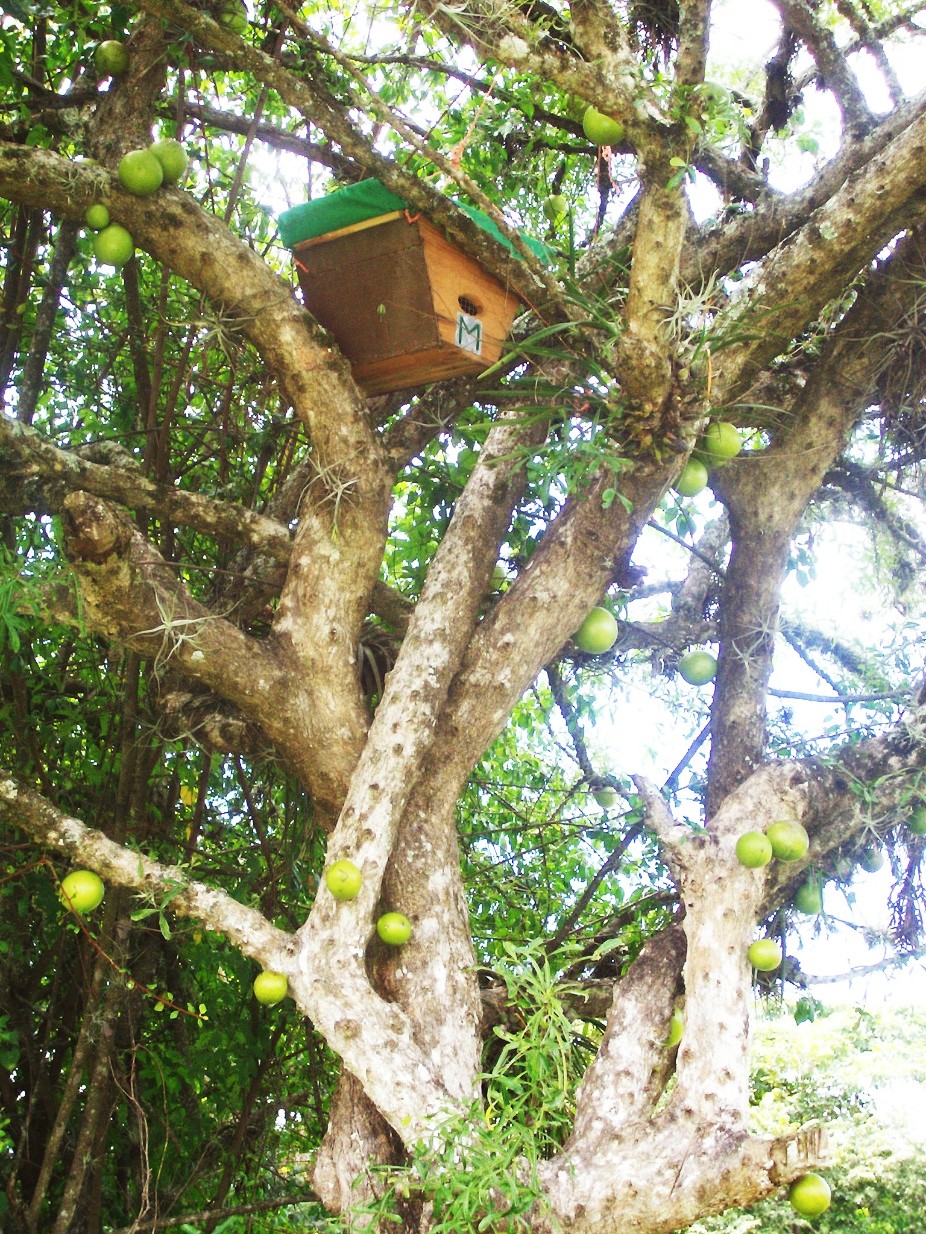
Trap hive in a jicaro tree.
What I have seen is that the trees which catch a swarm will work year
after year. In some particular trees I have caught as many as five swarms in
one season, hanging up one box after another as they get filled.
I try not to choose a tree that is in the very middle of woods. I prefer
the tree to be on the edge of a field or other open area. You want the scout
bees to easily find the box.
Ideally the tree is also within sight of a house so someone can keep an
eye on the trap. Kids are curious and have messed with my swarm boxes. Some
limbs and leaves to camouflage them are good.
Hanging
the trap hive.
What goes up has to come down. Hanging the trap hive is usually the easy
part. Removing it when there is a swarm inside can be difficult. Take this into
consideration.
Ideally l like to hang the trap about ten or twelve feet up in the tree.
This is out of reach (and usually out of sight) of kids from the ground. It is
also high enough so the eventual bees in them will not easily bother (or be
bothered by) cattle or horses that may be on the ground below the box. But at
the same time, trap hives hung lower, maybe only six or seven feet above the
ground, will also work. Africanized bees don’t seem to be that fussy. I’ve
caught swarms in extra trap hives that were setting on the ground behind my
house.

My
traps hive usually hang freely from their rope. At the same time, I try to rest
them against a limb or the tree trunk so they don’t move in the wind. The rope
used to hang them is thrown over a branch above them and tied off down below
where I can reach it from the ground. I tied this one off on a nail I pounded
into the tree.
I try to hang them so they can be easily lowered. A large swarm can
easily fill a box within two weeks, making it quite heavy. It can be difficult
and awkward to remove it, especially when one is trying to maintain his or her
own balance while standing on a tree limb.
I usually let the trap hive hang somewhat freely, only resting against a
branch to minimize movement in a wind. If necessary, it could even be tied
against the branch to help keep it more stable. I don’t set it on a limb or in
the crotch of a tree. All the weight is supported from the crossed ropes over
the top of the box. The main support rope is thrown over a branch above the
trap and tied off down below in an easily accessible place. After stuffing the
entrance, I basically just need to untie this rope and lower the trap to the
ground.
You could set the trap in the crotch of a tree but it sometimes causes
problems for the removal. Although the trap will stay steady, it will be necessary
to lift it up and out of the crotch to remove it. This can be difficult with a
heavy trap or if you only have one hand available (the other is around a branch
so you don’t fall).

An
example of what not to do with a trap hive. A big swarm moved into this box
that got set into the crotch of a tree. The trap was nice and stable but the
weight of the bees and their comb building after a couple weeks actually wedged
it in there. It didn’t want to come out of the crotch and the slippery bark of
this tree didn’t help us. We actually ended up having some combs collapse in
this one that night.
Removing
the trap hive from the tree.
I usually like to leave the trap hive up in the trees with the swarm for
a week or two. Since Africanized bees like to abscond more readily than
European bees, I don’t want to disturb the swarm until they get established
with comb and brood. When they are at this point I have no problems with them
wanting to take off. They normally have enough space in my swarm boxes to hold
them for three or so weeks.
The only thing you should need to do is stuff something into the
entrances and then lower it down. Always be prepared with a veil, even though
you may not need it. I usually have my simple mosquito-net string veil down
around my neck, ready to pull up if necessary. You may also want to have your
smoker lit and ready, for whatever emergency. Sometimes a group of bees will be
hanging outside the entrance and smoke will be necessary to coax them inside.
One person can lower the trap hive by himself, especially if enough
extra rope was used and it was hung in a way to make this simple. Two people
usually make the work easier. For example, if the rope is long enough, the
person on the ground can lower the box (an extra piece can be tied to it if
more would be needed). The person above in the tree guides the trap, maybe
swinging it out a bit to avoid branches below it. When within reach from the
ground, the person in the tree grabs the main rope while the person below will
grab the trap in his or her hands to lower it the final distance to the ground.

Marcos
stuffing a sponge into the entrance of the trap hive. The box was sealed up
except for the entrances on each side. I try to hang the trap hives in a way
that makes taking them out of the tree easy. Although Marcos could stand
comfortably on this limb to reach the swarm trap, he only had one hand
available to close up the hive and help lower it.
Finally, the trap hive and its bees are taken to the apiary and placed
on a hive stand where they will permanently stay.
Use care to avoid combs breaking in top bar trap hives. There are no
frames to support the combs. Lower the hive carefully and carry it gently to
the bee yard. Large swarms cause more problems than small ones. Within a week
or two, a large swarm can have full combs built, heavy with brood. One bad bump
can cause these new combs to collapse, making a mess and possibly killing the
queen in the process.
Finally, don’t forget to open the entrance once it is located in its
place in the apiary.
Transfer
to their permanent box.
I again wait at least a week before transferring the bees into their
permanent hive. I want them to get used to being in the new location. The
transfer is a rather simple process. Basically all the combs are lifted out of
the trap hive and placed into the permanent box. It takes more time to set up
the permanent box than it does to move the combs over to it.

The
transfer of the new hive into its permanent box is usually a simple
process—lift the combs out (two at a time in this case) and pass them into the
bee’s new home. I always try to keep the combs in the same order at this point.
I don’t specifically look for the queen but I do check the brood and its
pattern.
---Tom
Comments are always welcomed. Let me know what you do with your trap
hives or what you think of my system. I’m always open to answering questions.
If you found my blog post about swarm traps useful, please share it.
If you found my blog post about swarm traps useful, please share it.