Showing posts with label stingless bees. Show all posts

Monday, November 21, 2016

Musings on Bees in the Cemetery


I went for a walk the other Sunday to stretch my legs with Scooter, my dog. Of all the possible routes we could have taken, I decided to head for the town cemetery. I wanted to also go looking for some stingless bees. The cemetery is a good place for this. 

The older mausoleums begin to deteriorate and crack, so it gives the bees a place to enter the tombs. Most are small native stingless bees but occasionally you might find a colony of Africanized bees.


I didn’t even cover half of the cemetery. I found five colonies with four different varieties, including one with Africanized bees. 

The stingless bees got a little upset when I tried to get some photos of them. They started flying around and getting into my hair. They don’t sting but they do bite, sort of like an ant. Bothersome.

I won’t touch these bees, even though I would really like to have some of those stingless bee colonies (those are on my “to do/to have” list). There’s enough other ways to get bees, such as capturing swarms and splitting hives. 


Stingless bee colonies in the graves. One characteristic of many of them is the entrance tubes they make with a combination of wax and propoleos.

And there’s something that’s not quite right about entering a grave to get a colony of bees. It doesn’t sit well with me (and probably with most people for that matter). I’ve done it before, however, but at the request of the family. 

Many a year ago, a drunk guy pulled down the entrance plug of an old mausoleum in the town cemetery, which had cracked all the way around. This tomb had to be more than 50 years old. A colony of Africanized bees had moved into it. He wanted a bit of honey but instead got all stung up before high tailing it out of the cemetery. He left empty handed.

I was contacted to see if I could help. The colony had been causing problems anyways by stinging people when they would go to clean around the graves. Now it was opened.

It was a big colony and the first comb was right in the entrance of the grave, forming a wall of bees and wax that went from the top to the bottom. It was a bit bigger than two deep frames in size. There were about five of these before I got to the wooden casket. Some smaller combs continued over that. 

Two Langstroth boxes got filled with brood comb and bees. This old comb eventually got weeded out as the bees filled frames with new comb. The honey got dumped.

It’s kind of unnerving to go into a tomb but at times beekeepers are required to do this type of community service. I won’t go looking for the family of this newest mausoleum colony in order to ask them if I can remove it. But I suspect, if they come looking for me, I’ll say yes.
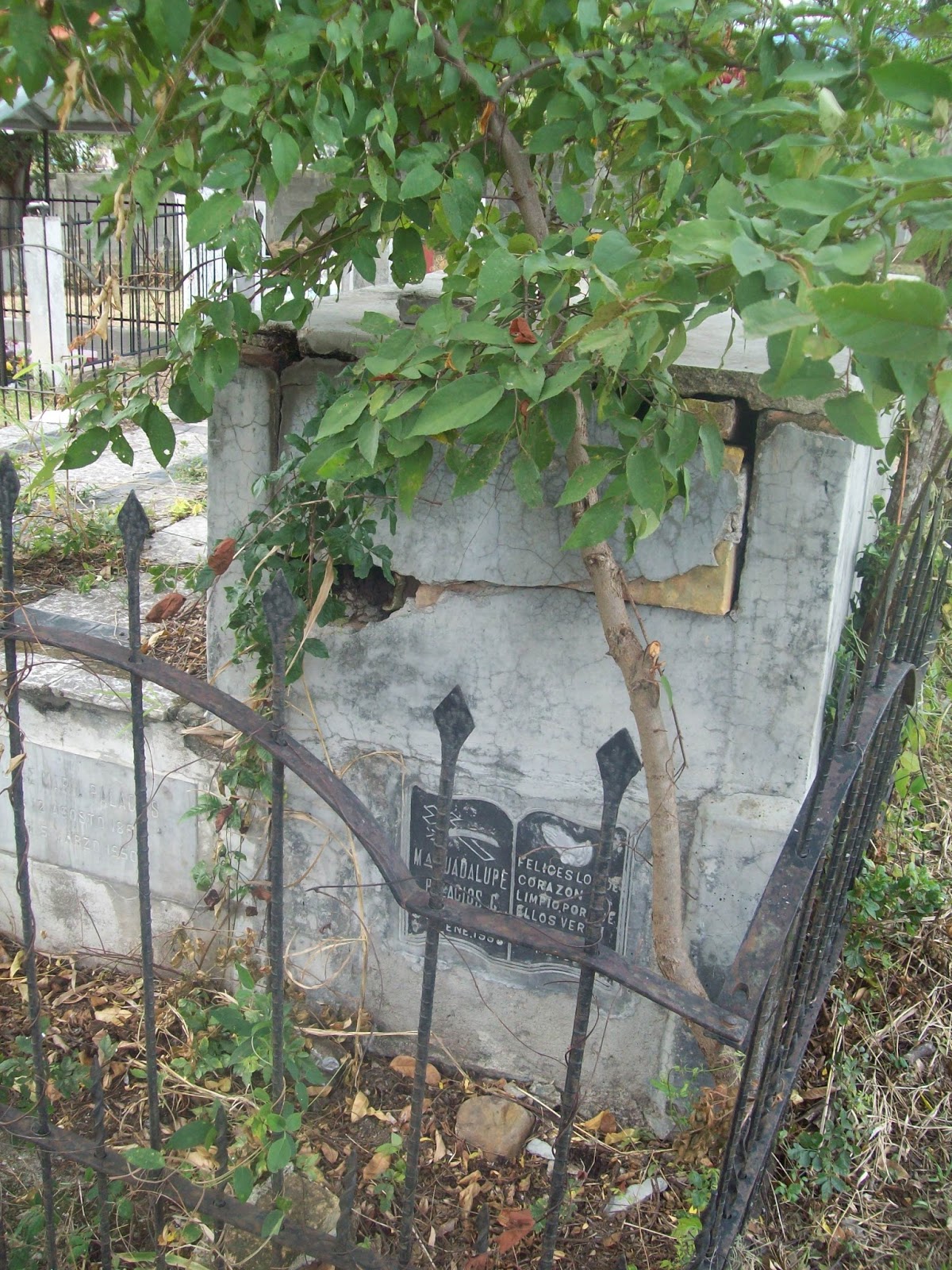

The mausoleum with the colony of Africanized bees. It looked like someone may have actually tried to remove the bees since the entrance plug is loose. But since there is no marker on the top part, maybe it’s empty—waiting to be filled.

Part of my plan was to find that first mausoleum to see if it had bees again. It’s in the old part of the cemetery, but I didn’t get that far. If I remember right, it got cemented shut but maybe it’s cracked again. It will have to wait for my next walk.

---Tom


A simple mausoleum in the town cemetery. The stingless bees had their entrance tube coming out of the upper left edge of the rounded plug for this grave.


An old grave in the cemetery, unusual for its shape. It was the only one I saw like this. The marker had if dated in 1948.


Some graves are humbler, marked with a simple wooden cross. Others have a small metal fence around the mausoleum and shrubs or flowers planted.


For more posts about my bee adventures in the cemetery, see these past entries:


If you enjoyed this blog post, please share on social media. 

Also, see my Facebook page  (“like” it!) and my companion blog in Spanish, Reflexciones Sobre Apicultura .

Comments are always welcomed.

Saturday, February 27, 2016

Musings About a Double Colony Hive


Seeing anomalies and other oddities is common enough with beekeeping in Honduras, because of both the Africanized bees present here and also the population of different native stingless bees. One these experiences for me involved a hive with two colonies.


When you read about bees you often come across information and references to double colony hives. Normally this is where the beekeeper will set up two distinct hives side by side, both with their own queen but who share a common stack of supers. Mine was a bit different—being that it formed naturally and with two distinct types of bees.

This anomaly, if you could call it that, began with a failed swarm catch. I went to get a swarm that a neighbor had probably told me was in one of his trees. But as is common with Africanized bee swarms, they don’t like to stick around when dumped into a box. The bees left after a day but the now-empty box stayed in the backyard, set up off to one side on a hive stand. And it stayed there for a good while, by itself under a couple small trees.

It was probably a good month or so later when I noticed the activity in the box. I was out in the backyard puttering with the rabbits or cutting the weeds with a machete when I happened to look over at the box. There was something coming and going from the entrance and my first thought was that a different swarm of honey bees had decided to take up residency in the box. Trap hives work very well here for getting swarms.


It turned out that they weren’t Africanized bees but a type of small black stingless bees that are native to Honduras. My wife often calls these “zacarias,” sometimes “magwas.” They almost look more like a fly. Although I have seen them before, I’m not quite sure what their true name is or the scientific one. They are the type of bee that will get into your face or your hair when riled up. But like other native bees, they don’t have a sting but will try to bite you, similar to an ant bite. They aren’t dangerous but can be very bothersome.

Like many stingless bees, they build a long tube as an entrance to the hive. Over the years the tube kept getting longer. It was common to see a bunch of the bees lined up all the way around the edge of the tube. Under it they built a bunch of sack-like structures. I´m not exactly sure of their purpose but someone suggested that maybe this is their way of confusing predators as to what is the actual entrance.


I had built their box as a swarm trap/nuc hive/swarm catching box—whatever the need may have been for a smaller box. It was big enough to hold seven of the frames I used in some of my Tanzanian-style top bar hives. The sides and bottom where actually a sheet of aluminum used by the printing presses of a newspaper. I wanted to keep it light weight so is would be easy to lower out of a tree. Bees in Honduras like my boxes just fine.

The hive ended up getting moved around a bit, even from one house to another. It eventually ended up in the backyard on the corner of an old broken down pila, a water basin common in houses in Honduras. My wife used it as a stand for some of her flowers and aloe vera plants.


Maybe a year later I remember I was again in the backyard working on something when I noticed activity on the backside of the box. I think my first thought was that the colony had gotten big enough to where they wanted to also use the back entrance I had in the box.

I went to investigate and the bees turned out to be Africanized. What a surprise. The stingless bees must not have needed that much room so there was enough left over for a small swarm of Africanized bees to move in. The stingless bees, I later learned, actually made a type of wall out of cerumen, a mixture of propolis/tree resin and wax—an effective barrier which caused the two colonies to live together but not mix together. The box was now officially a duplex.


That is how they stayed for the longest time. I remember taking honey from the Africanized colony only one time, a bit of florescent yellow honey with a greenish ting—probably from the madreado trees that grow in the valley. Excellent flavor. Otherwise hive just stayed in the backyard as a curiosity—something to watch and ponder about.

I eventually lost it, during one of the times I was back in the States working for a commercial beekeeper. Neither my wife nor I are sure about exactly what happened to it. Maybe it was ants, which would be a good guess since they can cause bees a lot of problems here in Honduras. All I know is that I came home to a box without bees.


I had the chance to really see the inside of the hive after the colonies had disappeared. The structure of the Africanized bees´ nest is similar to other honeybees. The combs are built vertically and hang from the top of the cavity. But unlike the hives beekeepers manage, the bees don´t naturally keep all the combs parallel to each other. Notice the combs in the photo that was built perpendicular to the others. 

The stingless bees, on the other hand, will build their brood comb horizontally, layered one on top of the other like a cake. Small pylons will keep them separated. The honey and pollen are stored in “pots” that the bees build around the brood areas—round balls opened on the top.­


----------
Tom


Also see my companion blog in Spanish, “Reflexiones Sobre Apicultura.”